Quilt's Benchling Packager has become the standard route for pre-clinical data at Arbor Biotechnologies, linking datasets to the experimental records scientists already use and making cross-assay analysis faster and more practical.
Arbor Biotechnologies is a clinical-stage, next-generation gene editing company based in Cambridge, MA, developing first-in-class genomic medicines for serious diseases with no functional cures. Its pipeline includes CNS programs initially prioritizing ALS and ABO-101, a co-developed clinical program for primary hyperoxaluria type 1.
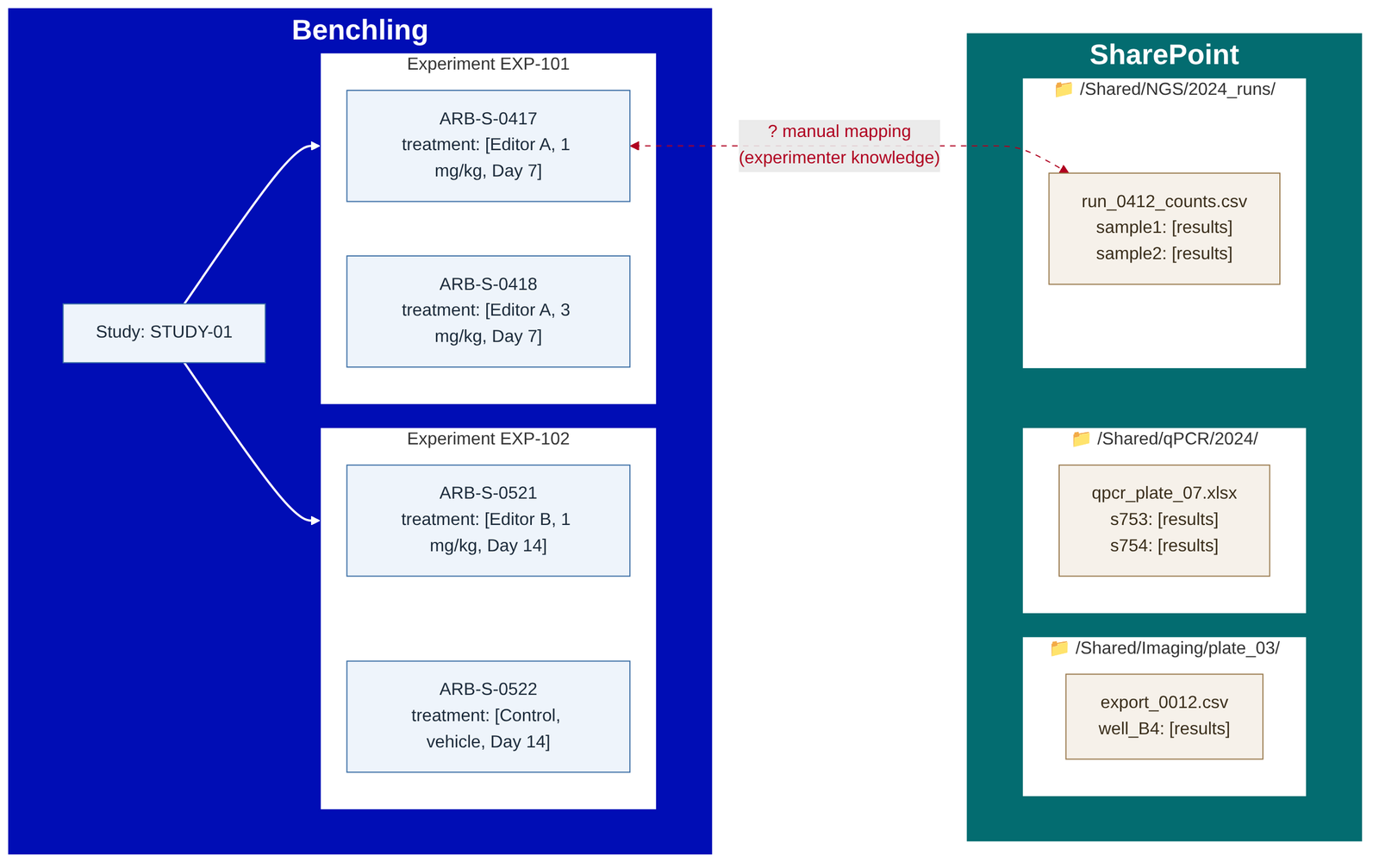
Before Arbor connected Quilt and Benchling, pre-clinical results were stored in SharePoint, while the experimental design that gives those results their meaning was recorded in Benchling. As Arbor's data grew, connecting results back to experimental design was taking more manual effort than it should.
Arbor has run a Quilt catalog since 2023, holding terabyte-scale sequencing data alongside imaging and other pre-clinical results. Quilt's Benchling Packager is now part of the standard route by which that data enters Arbor's systems.
“Quilt's Benchling Packager is required now for all of our pre-clinical experiments.” — Austin Jones, Associate Director, Software Engineering
Before the direct connection of results to experimental metadata, samples submitted through different workflows were often labeled using conventions local to each workflow, e.g., “sample 1” through “sample 1000.” Those labels served the scientist running the experiment well, but mapping them back to the experimental design relied on that scientist's context, making it harder for colleagues to build on the results.
“We want data generated today to be just as useful two or three years from now, to anyone on the team, not just the scientist who ran the experiment.” — Austin Jones, Associate Director, Software Engineering
The need grows when several readouts involve shared samples. Arbor needed the relationships already represented in Benchling—among studies, experiments, and samples—to remain connected to the corresponding data rather than be reconstructed from filenames or folder structures.
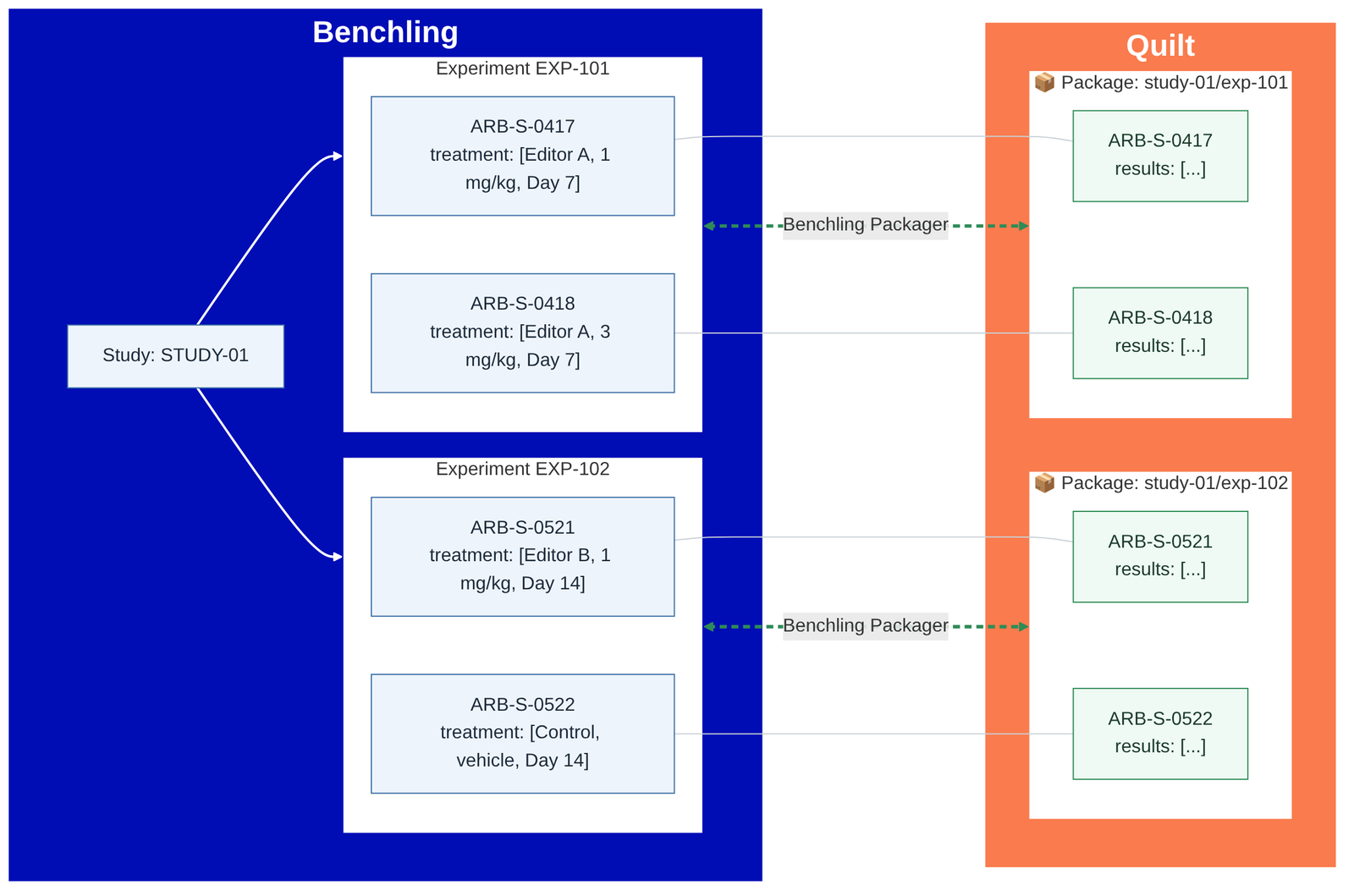
The Benchling Packager gives the two systems distinct roles. Benchling holds Arbor's experimental records and object model. Quilt holds the associated data as packages. Scientists put data into a Quilt package and associate it with the relevant Benchling record, preserving a link between the dataset and the experiment.
That association lets Arbor use scientific relationships it already maintains in Benchling. Related experiments can be grouped into studies, and samples can be associated across those experiments. Instead of creating a second description of the work in a storage hierarchy, Arbor can organize access to the data around the experimental structure.
The change is procedural as well as technical: readout registration happens through the same system scientists already use to register their experiment.
“Quilt's Benchling Packager gives us full visibility of a given experiment: protocol description, sample registration, scientist observations, raw data files, and analysis. This makes peer review a much less burdensome process and makes experimental outcomes substantially more reusable. This is especially important for large, complicated datasets generated from high-resolution microscopy or next-generation sequencing.” — Austin Jones, Associate Director, Software Engineering
With data associated to experimental records, researchers can begin with the experiment rather than a folder or filename. The organization matters most when the same samples appear across multiple experiments: Arbor can group those experiments into a study through Benchling's object model and retain the sample associations needed to compare their data.
“By linking Quilt and Benchling, we can streamline cross-functional collaboration, improve data accessibility, and enable teams to leverage information across scientific and operational workflows.” — Walter Flores, Associate Scientist, Translation Research
For Arbor's scientists, that progress means experimental records can remain connected to the data used across experiments—making cross-experiment analysis more practical while leaving room to improve the workflow further.